Vehicle armor solutions
From wheeled armored vehicles to main battle tanks: protection up to STANAG 4569 levels with appliqué armor, spall liners, ceramic and composite systems.
01 — Company
Comprehensive vehicle armor for land, naval and air platforms — from raw material to finished armor, in-house.
KG Savunma is a vertically integrated Turkish defence manufacturer specialising in advanced ballistic protection systems. With three dedicated production facilities in Ankara and over 610 personnel, it delivers end-to-end solutions from raw-material production to finished armor kits.
- 3 Production facilities
- 76.200 m² Total production area
- 610+ Specialised personnel
- 9 Ministries of Defence worldwide
02 — Production capabilities
Production capabilities
-
#01
CNC Machining Factory
5-axis CNC milling and turning, CMM inspection, precision metal components.
-
#02
Materials Factory
UHMWPE fibre, alumina, SiC and B₄C ceramic production; ballistic laboratory.
-
#03
Composites Factory
UD fabric, hydraulic press, autoclave, CNC machining, injection moulding.
03 — Product portfolio
Product portfolio
-
Appliqué Armor
Lightweight add-on armor for enhanced ballistic protection up to STANAG Level 4.
-
Spall Liners
Internal fragment and blast protection to shield vehicle occupants.
-
Ceramic Armor
In-house alumina, SiC and B₄C ceramic tile systems.
-
Composite Systems
Complete survivability and structural armor — up to 50% lighter than steel.
04 — Applications
Applications
- Wheeled armored vehicles
- Main battle tanks
- IFVs & APCs
- Naval platforms
- Air platforms
- Special purpose vehicles
05 — STANAG 4569 protection
STANAG 4569 protection levels
06 — Ceramic armor technology
Ceramic armor technology
-
Alumina Ceramics Al₂O₃
30.000–50.000 tiles/day
- Continuous oven technology
- Cost-effective solution
- Various geometries
- Hybrid system integration
-
Silicon Carbide SiC
4.000 plates/week
- High hardness
- Enhanced protection
- Specialised applications
- Optimised for weight-sensitive use
-
Boron Carbide B₄C
1.000 plates/week
- Premium ballistic performance
- High hardness and low density
- Special formulations
- Lowest areal density available
07 — Panel architecture
Panel architecture
- 01Ceramic tile layer (Al₂O₃ / SiC / B₄C)
- 02Adhesive layer
- 03UHMWPE composite backing
- 04Optional spall liner
- 05Edge protection
- 06Mechanical fixation
- Square tiles — flat panels & large coverage
- Hexagonal tiles — optimised multi-hit
- Cylindrical elements — curved surfaces
- Dome shape — enhanced deflection
08 — Protection systems
Protection systems
-
Appliqué armor systems
- Modular, easy integration
- Up to STANAG Level 4
- Optimised protection-to-weight
- Field-maintainable
-
Spall liner solutions
- Reduces secondary fragments and spall
- Flexible and lightweight
- Tailored to different platforms
- Anti-flash / anti-fire options
-
Aluminium foam & anti-mine
- High energy absorption
- Reduces underbody blast effects
- Lightweight and durable
- Proven for mine and IED
-
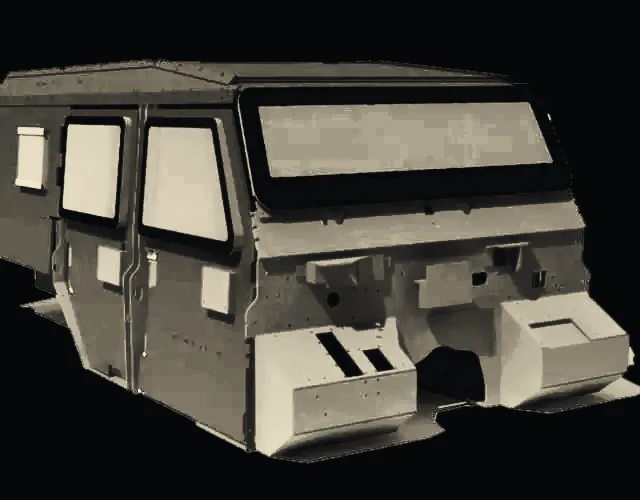
Composite survivability systems
- Full vehicle armor capsules
- Structural composite solutions
- Significant weight reduction
- Design, analysis & production in-house
09 — Levels of protection
Levels of protection
-
1
Ballistic protection
Defeat of high-velocity projectiles including AP and APDS.
-
2
Fragment & spall protection
Protection against secondary fragments and spall.
-
3
Mine & blast protection
Energy absorption against mines, IEDs and blast threats.
10 — Competitive advantages
Competitive advantages
-
Vertically integrated
From raw materials to finished systems.
-
In-house ceramics
Alumina, SiC and B₄C production.
-
Proven capabilities
Land, sea and air platforms.
-
Custom solutions
Tailored to customer requirements.
-
Cost effective
Optimised performance and pricing.
-
Fast delivery
Scalable production capacity.
11 — Testing & quality assurance
Testing & quality assurance
-
Ballistic testing
Validation in our in-house ballistic lab.
-
Material characterisation
Ceramic and composite material testing.
-
Environmental testing
Durability and life evaluation.
Figures are typical/illustrative values provided by the manufacturer; they are tailored to project requirements and confirmed during the quotation process.